4.3 Inter-VLAN Routing using Layer 3 Switches
4.3.1 Layer 3 Switch Inter-VLAN Routing
В enterprise networks чаще используют Layer 3 switches, а не router-on-a-stick.
Причина проста:
- выше performance;
- меньше latency;
- лучше scalability.
Layer 3 switch умеет:
- route between VLANs using
SVIs; - превращать Layer 2 port в routed port.
routed port — port на Layer 3 switch, который работает как router interface, а не как switchport. networkterm
4.3.2 Layer 3 Switch Scenario
В этом сценарии один Layer 3 switch сам даёт default gateway для hosts из разных VLANs.
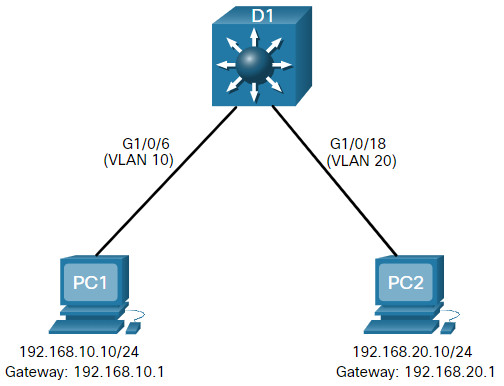
Пример:
| VLAN | SVI IP Address |
|---|---|
| 10 | 192.168.10.1/24 |
| 20 | 192.168.20.1/24 |
4.3.3 Layer 3 Switch Configuration
Пример конфигурации:
D1(config)# vlan 10
D1(config-vlan)# name LAN10
D1(config-vlan)# vlan 20
D1(config-vlan)# name LAN20
D1(config-vlan)# exit

D1(config)# interface vlan 10
D1(config-if)# description Default Gateway SVI for 192.168.10.0/24
D1(config-if)# ip address 192.168.10.1 255.255.255.0
D1(config-if)# no shutdown
D1(config-if)# exit

D1(config)# interface vlan 20
D1(config-if)# description Default Gateway SVI for 192.168.20.0/24
D1(config-if)# ip address 192.168.20.1 255.255.255.0
D1(config-if)# no shutdown
D1(config-if)# exit

D1(config)# interface GigabitEthernet1/0/6
D1(config-if)# switchport mode access
D1(config-if)# switchport access vlan 10
D1(config-if)# exit

D1(config)# interface GigabitEthernet1/0/18
D1(config-if)# switchport mode access
D1(config-if)# switchport access vlan 20
D1(config-if)# exit

D1(config)# ip routing
interface vlan 10 ciscoIOScommand
Создаёт SVI для VLAN 10.
ip routing ciscoIOScommand
Включает IPv4 routing на Layer 3 switch.
Это критично:
без ip routing switch может иметь SVIs, но не будет нормально route between VLANs.
Частая ошибка
Создать SVI и забыть
ip routing.
4.3.4 Layer 3 Switch Inter-VLAN Routing Verification
Здесь опять полезны:
ipconfigна host;pingмежду VLANs.
Если hosts из разных VLAN пингуются, значит inter-VLAN routing уже работает.
4.3.5 Routing on a Layer 3 Switch
Если VLAN networks должны быть доступны другим Layer 3 devices, нужен routed uplink.
То есть один port можно перевести из switchport в Layer 3 interface.
Команда:
no switchportno switchport ciscoIOScommand
Отключает Layer 2 switchport behavior и превращает interface в routed port.
4.3.6 Routing Scenario on a Layer 3 Switch
В этом сценарии Layer 3 switch не только route’ит между VLANs локально, но и общается с внешним router.
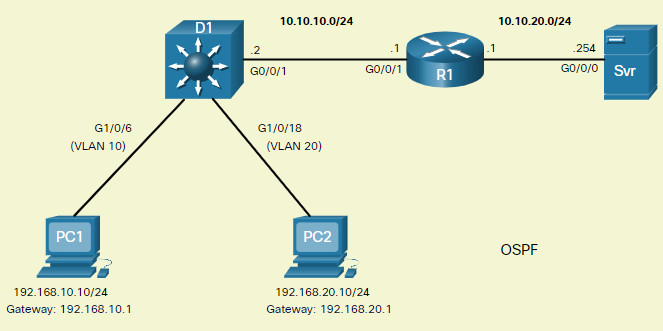
Обычно для этого используют:
- routed port;
- static routing или dynamic routing protocol.
Здесь в примере используется OSPF.
OSPF (Open Shortest Path First) — динамический routing protocol. abbreviation
4.3.7 Routing Configuration on a Layer 3 Switch
Пример:
D1(config)# interface GigabitEthernet1/0/1
D1(config-if)# description routed Port Link to R1
D1(config-if)# no switchport
D1(config-if)# ip address 10.10.10.2 255.255.255.0
D1(config-if)# no shutdown
D1(config-if)# exit

D1(config)# ip routing

D1(config)# router ospf 10
D1(config-router)# network 192.168.10.0 0.0.0.255 area 0
D1(config-router)# network 192.168.20.0 0.0.0.255 area 0
D1(config-router)# network 10.10.10.0 0.0.0.3 area 0
router ospf 10 ciscoIOScommand
Запускает OSPF process 10.
network 192.168.10.0 0.0.0.255 area 0 ciscoIOScommand
Добавляет network в OSPF area 0.
4.3.8 Packet Tracer – Configure Layer 3 Switching and Inter-VLAN Routing
Это уже более “production-like” вариант inter-VLAN routing.
Если понял тему, то ты должен различать:
- локальное inter-VLAN routing через SVIs;
- внешнюю routed connectivity через routed port.
Итог темы
Layer 3 switch = SVIs for VLANs + ip routing + optional routed uplink